

How To Filter Led Light
Installing, setting up and hanging an LED abound light and getting the altitude right
A possibly obvious topic to some, but centre-opening to others. We've seen all types of unique grows. Each of the states has our own conditions, limitations, and possibilities to construction our abound space. Whether we grow cannabis, vegetables, or indoor plants, this article will assistance in understanding how calorie-free falls and why getting the right elevation between indoor plants and abound light is important.
Let'southward begin with a bit of theory. In other articles, we've discussed that low-cal is photons and that photons are particles with wavelengths. To make up one's mind how intense lite is, we mensurate how many photons fall in a specific expanse. We exercise this with a quantum meter. In our instance, we do it with an Apogee MQ-500. Photons practise not fall in a straight line though. They sort of besprinkle almost and fall in a somewhat organized chaos. This means that the further a light source is from the area it'south supposed to illuminate, plants' canopies, for instance, the more photons volition spread sideways instead of falling straight down. This is non necessarily a bad thing as this creates a larger light footprint; a larger surface area covered with calorie-free. Nevertheless, to stimulate our plants, we still want enough photons to autumn on them.
[ More LEDTonic tests and guides]
The term for low-cal intensity, or photon density, is PPFD. We measure PPFD in umol/m2/s. Nosotros know that mature weed plants want 600-800 PPFD to exist stimulated. This means that we need to adjust our grow light so that nosotros project this intensity onto our plants. PPFD levels tin can be regulated with distance. Equally photons spread, the longer the distance between constitute and lite source is, the less intense the low-cal volition become as the photons spread sideways, away from the found.
Here's an illustration:

Nosotros see here that a lamp is emitting photons and that at that place is some distance between the lamp and the plant. If we were to move the found upward, closer to the lamp, fewer photons would escape beside the institute. If nosotros were to place the establish directly underneath the lamp, with null air between them, pretty much all photons emitted from the lamp would hit the institute -- no photons would "escape".
This is the theory behind distance:intensity:footprint.
Short or no distance betwixt lamp and constitute: loftier PPFD (light intensity) but small low-cal footprint (coverage area).
Long distance, permit'southward say two' (61cm) between lamp and found: low PPFD but large lite footprint.
This theory is also confirmed on our PPFD light footprint map of our lamps. We've measured the PPFD at 12", 18" and 24" distances and we clearly come across that the higher up the lamp is from the sensor, the less intense (lower PPFD) the calorie-free becomes but the PPFD levels in the outer edges increase as the distance increases.

What we should as well have away from the "photons spreading" theory is that the smaller the grow space, while of course all the same giving room for the plants, the better. Adding reflective walls to our grow space will make the escaping photons reverberate dorsum towards the plants. Grow tents already come up with mylar walls simply mylar tin can easily be purchased on its own and fixed to whatever grow area.
We tested this theory. Nosotros accept previously measured our grow lights in 3x3' tents which nosotros know are too large for the lights. We chose this size mainly to demonstrate how light intensity changes the further we move from the center spot. Our Z5 light works very well in a 2x2' tent, which is what we wanted to find out.


Nosotros come across that we get above 22% more photons inside the 2x2' area at 12" and above 34% at 24" compared to the 3x3' tent. Point being, if you can abound in a 2x2' tent, do not oversize and go with a larger tent. Choose the smallest possible tent that fits your plants.
[ More than LEDTonic tests and guides]
While we're at information technology, we likewise wanted to show you unlike ways to hang grow lights -- any grow light, just we'll demonstrate on our Z5. There are several ways to hang the grow light without even ratchets or a hook.

Connect the loops (two artillery) from the hanger two by two and connect each set of two loops to ane terminate of a ratchet. Guide the ratchet around the tiptop frame of your grow tent.

Use ii ratchets and connect ii loops (two arms) from the metallic hanger to each of the ratchets. Guide the ratchets around each side of the tent and secure them at the lesser of the tent.
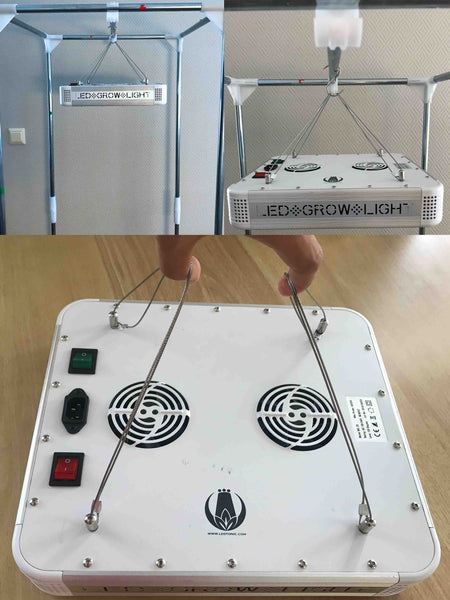
Place one loop from each arm straight beyond from where the arm's spiral cap volition be secured. Screw the cap on top of the loop. Hang the lamp with a hook, ratchet, or a metal wire (not included).
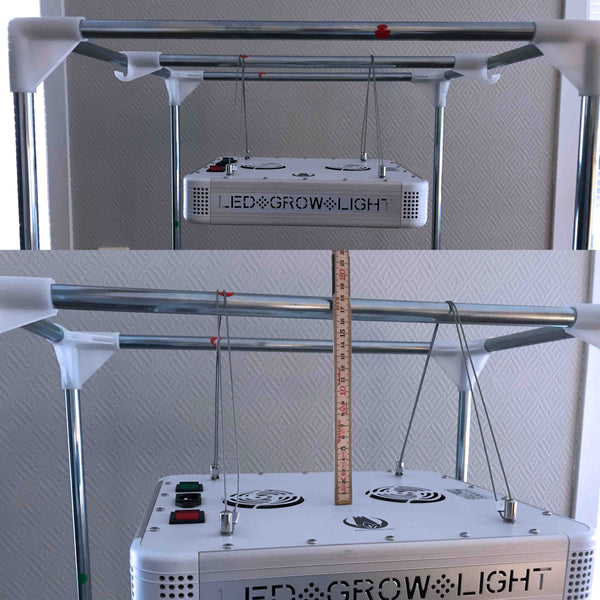
Same every bit above just instead of a hook the lamp hangs from a secure rod at the tiptop of the grow tent. Altitude between rod and lamp: 6.3" / 16 cm.

The hanger'due south artillery can be crossed to shorten them farther.

Same every bit above but use two rods to subtract altitude between lamp and top of tent. 2.75" / vii cm.
Ok. And so, takeaways:
- Hang the lamp at the correct height based on your plants' PPFD needs (check PPFD/PAR info from manufacturer).
- Brand sure the lite footprint is large enough to illuminate your plants (based on manufacturer'due south calorie-free footprint map).
- Create a compact grow area with no/minimal space betwixt your mature plants and reflective walls to absorb as much light as possible.
- At that place are many means to hang a grow light and we listed some of them.
Nosotros too made a video near this and we show a real example of how reflective walls work and affect the light footprint.
Happy farming!
[ More than LEDTonic tests and guides]

How To Filter Led Light,
Source: https://www.ledtonic.com/blogs/guides/instructions-how-to-hang-setup-an-led-grow-light
Posted by: bookerestinabot1938.blogspot.com
0 Response to "How To Filter Led Light"
Post a Comment