

What Size Air Filter For A 1994 Chrysler New Yorker
| Chrysler LA engine | |
|---|---|
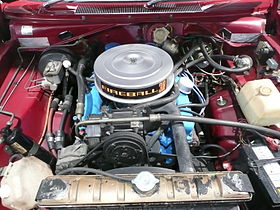 LA engine installed in a 1976 Charger coupé | |
| Overview | |
| Manufacturer | Chrysler |
| Also chosen | Magnum engine |
| Production | 1964–2003 |
| Layout | |
| Configuration |
|
| Block material | Cast fe |
| Head material | Cast iron |
| Valvetrain | OHV ii valves per cylinder |
| Combustion | |
| Fuel system |
|
| Fuel type | Gasoline |
| Oil system | Wet sump |
| Cooling system | H2o-cooled |
| Chronology | |
| Predecessor | Chrysler A engine Chrysler B engine |
| Successor |
|
The LA engines are a family of pushrod OHV small block 90° 5-configured gasoline engines built by Chrysler Corporation. It was factory-installed in passenger vehicles, trucks and vans, commercial vehicles, marine and industrial applications from 1964 through 1991 (318) & 1992 (360). The combustion chambers are wedge-shaped, rather than the polyspherical combustion chambers in the predecessor A engine or the hemispherical combustion chambers in the Chrysler Hemi engine. LA engines have the aforementioned iv.46 in (113 mm) bore spacing equally the A engines. LA engines were made at Chrysler'southward Mound Road Engine establish in Detroit, Michigan, also as plants in Canada and United mexican states. The "LA" stands for "Calorie-free A", as the older "A" engine it was closely based on was nearly 50 pounds heavier.[1] Willem Weertman, who later became Chief Engineer – Engine Blueprint and Development, was in charge of the conversion.[one] The basic design of the LA engine would go unchanged through the evolution of the "Magnum" upgrade (1992-1993) and into the 2000s with changes to enhance power and efficiency.[1]
239 V6 [edit]
The 238.2 cu in (3.nine L) V6 was released in 1987 for use in the Dodge Dakota and a replacement for the older, longer Slant-Six for the Dodge RAM. It is essentially a six-cylinder version of the 318 V8. Output was 125 hp (93 kW) and 195 lb⋅ft (264 Due north⋅chiliad) until it was replaced by the Magnum iii.nine starting in 1992. In 1987 information technology used a two-barrel Holley carburetor and hydraulic tappets. In 1988 it was upgraded with throttle-body fuel injection and roller tappets which information technology retained until the 1992 Magnum update. Next, in the 1992 Magnum update, the throttle-torso fuel injection was upgraded to a multi-port fuel injection. The engine was produced through 2004 before it was replaced with the 3.7 Fifty Power Tech V6.
273 V8 [edit]
The 273 cu in (4.5 Fifty) was the first LA engine, beginning model year 1964 and offered through 1969, rated at 180 hp (134 kW). It had a bore and stroke of 3.625 in × three.31 in (92.1 mm × 84.ane mm). It had a mechanical solid lifter valvetrain until 1968 when hydraulic lifters were introduced; hydraulic lifters generally make for a quieter valvetrain. The reciprocating assembly included a bandage or forged steel crankshaft, drop forged steel connecting rods and cast aluminum pistons. The valvetrain consisted of a bandage nodular fe camshaft, solid or hydraulic lifters, solid pushrods and shaft-mounted, malleable fe rocker arms (stamped steel on later hydraulic-cam engines). These actuated the overhead steel intake and exhaust valves. The cylinder heads featured wedge-shaped combustion chambers with a single intake and a single exhaust valve for each cylinder. Spark plugs were located in the side of the cylinder head, between the exhaust ports.[1]
A loftier functioning 235 hp (175 kW) was offered 1965-'67, this was standard in the Barracuda Formula S model and optional in all other meaty models excluding station wagons. It featured a 4-bbl. carburetor and matching intake manifold, chrome unsilenced air cleaner with callout sticker, longer-duration and college-lift camshaft and stronger valve springs, ten.five:1 compression ratio, special black wrinkle valve covers with extruded aluminum appliques, and a depression-brake exhaust organization with a two.v in (64 mm) exhaust pipe, collector-type Y-junction, and exposed resonator. In 1965 (only) the muffler was of "straight through" construction.
A special version was besides available in 1966 simply - it used a 0.5 in (12.7 mm) lift solid-lifter camshaft, fabricated-steel-tube exhaust, and a Holley 4-barrel carburetor, producing 275 hp (205 kW) (1 hp/cu in). Information technology was available in the Dodge Dart just, and the machine then equipped was called the "D-Dart", a reference to its classification in NHRA D-stock for drag racing, which was the machine's only intended purpose.
318 V8 [edit]
The LA 318 was a 317.five cu in (five.ii L) relative of the A 318. Like the A 318, it has a bore & stroke of iii.9062 in (99.2 mm) Ten 3.312 in (84.ane mm). It appeared in volume production first with the 1968 model year, replacing the solid lifter 'A' engine version that was equipped with the polyspherical chambered heads. The LA engine was available until 1991 when it was superseded by the Magnum version (See below). It used hydraulic lifters and a 2 butt carburetor for most of its product, though 4-barrel Carter Thermo-Quad and Rochester Quadrajet carburetors were used in police applications starting in 1978. The 318 received roller lifters and a fast-burn down chambered cylinder head in 1985. Throttle-trunk electronic fuel injection was factory equipment on the 1981-1983 Regal. From 1988 to 1991, another throttle-body fuel injection system was used for truck and van applications.
340 V8 [edit]

The base of operations 340 cu in (5.half dozen L) came with a 4-barrel carburetor and produced 275 hp (205 kW) gross
In the mid-1960s, Chrysler decided to adapt the 318 cu in (five.two 50) small block V8 into a lightweight, high output engine equally suited for drag strip or street performance apply. Its cake was bored out to 4.04 in (102.6 mm) but three.31 in (84.one mm) stroke left unchanged, resulting in the 340 cu in (5.half dozen L) engine introduced for the 1968 model twelvemonth. Anticipating higher loads resulting from racing operation, the engineers fitted a forged shot peened steel crankshaft instead of the cast nodular iron unit used in the 318. This likewise included shot peened hammer-forged steel connecting rods and high compression cast aluminum pistons with full floating pins. A four-butt carburetor was mated to a high-rise, dual plane intake manifold feeding high-period cylinder heads that are still considered amongst the best of that era. [ citation needed ] Its big ports used 2.02 in (51 mm) intake and i.60 in (41 mm) exhaust valves. An aggressive cam was fitted to have advantage of the much better breathing top end. The 1968 iv-speed cars got an even hotter cam, but it was discontinued for 1969, where both automatic and transmission cars shared the same cam. The engine was equipped with hydraulic lifters and two commodities chief bearing caps, leading some to initially underestimate the 340's potential. The 1968-'71 340'south compression ratio was x.v:1, placing it near the limit of what was possible on pump gasoline during that era. The 340 also used additional heavy-duty parts, such equally a double-row roller timing chain and sump-mounted windage tray. Power output was officially stated as 275 hp (205 kW) gross for the iv barrel.
In 1970, Chrysler offered a special Half-dozen-Pack version of the 340 with triple 2-barrel carburetors rated at 290 hp (216 kW) gross that was specific to Challenger TA and Cuda AAR models. This version featured a heavy duty short block with additional webbing to allow for aftermarket installed 4 bolt main bearing caps. The application-specific cylinder heads featured relocated intake pushrod passages with outset rocker arms that immune the pushrods to be moved away from the intake ports, which could ameliorate airflow if the pushrod-clearance "hump" was ground away from the intake port by the end user. An aluminum intake manifold mounted three Holley carburetors, and a dual points ignition arrangement was fitted.
The combination of rising gasoline prices and insurance company crackdown on high-operation vehicles saw the relatively expensive 340 detuned and phased out. It remained a high performance engine through 1971, simply was de-tuned in 1972 with the introduction of low pinch (8.5:i) pocket-size valve heads, and by mid-year, a cast nodular atomic number 26 crankshaft, and a variety of other emissions related changes. For the 1974 model year it was replaced by the 360 cu in (5.9 L) engine.
360 V8 [edit]

360 cu in (5.9 L) V8 in a Li'fifty Red Express Truck
The LA 360 cu in (five.9 L) has a bore and stroke of four in × 3.58 in (101.6 mm × 90.9 mm). It was released in 1971 with a 2 barrel carburetor. The 360 used the big intake port 340 heads with a smaller intake valve of 1.88 in (48 mm). In 1974, with the introduction of the code E58 iv-BBl dual exhaust version, at 245 hp (183 kW) SAE net, became the most powerful LA engine with the end of 340 product. Power started dropping from 1975 on as more emission controls were added resulting with the 1980 E58 engine only producing 185 hp (138 kW) SAE net. Starting with 1981, the 360 was exclusively used in Dodge trucks and vans.
The 1978-1979 Li'l Red Express truck used a special high-performance 360 iv-barrel engine with mill product code EH1 that was rated at 225 SAE Cyberspace HP in product course [two]The EH1 was a modified version of the E58 360 police engine (E58) producing 225 hp (168 kW) net at 3800 rpm due in part, that equally it was installed in a "truck", and not a car, it did not have to use catalytic converters (1978 but) which allowed for a free-flowing exhaust system. Some prototypes for the EH1 featured Mopar Operation W2 heads, although the production units had the standard 360 heads. Some police force package cars came from the manufacturing plant with a steel creepo and h-beam rods.[three] At that place was also a "lean burn" version of the 360. The LA360 was replaced in 1993 by the 5.nine Magnum, which shared some design parameters with the LA360, however the majority of its components were different.
Due to additional modifications, the image Li'l Cerise Express truck tested by diverse period magazines ran appreciably stronger than actual product examples.[4]
Acting solutions: the throttle body injected LA engines [edit]
The last variation of the LA series to be introduced before the Magnum upgrade was the 1988-92 throttle-body fuel injection, roller cam engine. The get-go engines to receive these modifications were the 318 cu in (5.two L) V8 and 239 cu in (3.nine L) V6 engines. A Holley/Chrysler-designed, single-bespeak, twin-injector throttle body assembly that was mounted atop a slightly re-designed cast atomic number 26 intake manifold. An in-tank electric pump and reservoir replaced the earlier mechanical (camshaft-eccentric driven) pump. The valvetrain was upgraded to include hydraulic roller lifters, nevertheless cam specs remained substantially unchanged. The resulting engine was somewhat improved equally to power and efficiency. The 5.nine 50 V8 engines followed suit in 1989, but too received the overall improved "308" cylinder heads (casting number 4448308) that featured significantly higher flowing frazzle ports and a return to the original 1971 (non fast fire) combustion sleeping accommodation. However, with other manufacturers already introducing the superior multi-point fuel injection system, Chrysler Corporation considered a more drastic upgrade programme.[1]
As the TBI engines were being introduced, the new upgrade program was initiated in the Chrysler engineering department. In 1992, with emissions standards becoming e'er more than stringent in the United States, Chrysler Corporation released the showtime of the upgraded engines.[1]
Magnum engines [edit]
In 1992, Chrysler introduced the start of a serial of upgraded versions of the LA engines. The company named their engine the "Magnum", a marketing term that had been used past the company previously to draw both the Dodge Magnum automobile and an earlier Contrivance rider car (merely) engine series; the latter was based on the big-cake B/RB V8 engines of the 1960s-70s.[one]
The Chrysler Magnum engines are a series of V6, V8, and V10 powerplants used in a number of Chrysler Corporation motor vehicles, equally well every bit in marine and industrial applications. This family of gasoline-burning engines lasted for over a decade, were installed in vehicles sold across the globe, and were produced in the millions.
Technical information [edit]
The Magnum engine is a directly descendant of the Chrysler LA engine, which began with the 273 cu in (4.v 50) V8 in 1964.[i] While the Magnum three.9, Magnum five.two, and Magnum 5.9 (1992-upwardly) engines were significantly based on the 239, the 318, and the 360 — respectively — many of the parts will not directly interchange and the Magnums are not technically LA engines; the merely major parts that are actually unchanged are the connecting rods.
The cylinder block remained basically the same. It was still a V-shaped, 90-degree blueprint made of cast iron. The crankshaft, located to the lesser of the block by 5 main bearing caps, was bandage nodular iron, and the 8 connecting rods were forged steel. The pistons were cast aluminum, with a hypereutectic blueprint.[v] Cylinders were numbered from the front of the engine to the rear; cylinders 1, 3, 5 and vii were found on the left (driver side) bank, or "bank i", with the even numbers on the other depository financial institution.[six]
Coolant passages were located betwixt the cylinders. The gerotor-type oil pump was located at the bottom rear of the engine, and provided oil to both the crankshaft main bearings and the cylinder heads (via the lifters and pushrods, equally opposed to a drilled passage on LA engines). Chrysler's engineers also redesigned the oil seals on the crankshaft to improve anti-leak seal performance.[v] [7] The oil pan was likewise made from thicker steel, and was installed with a more leak-resistant silicone-rubber gasket.
Gasoline was supplied to the intake manifold through a pair of steel rail that fed eight Bosch-type, pinnacle-fed, electronically actuated fuel injectors; there was one injector located in each intake runner.[8] Each cylinder had its own injector, thus making the fuel system a "multi-point" type. Fuel pressure was regulated by a vacuum-controlled force per unit area regulator, located on the return side of the second fuel rail. Excess fuel was thereafter delivered back to the fuel tank. (Afterward versions had the regulator and filter mounted at the in-tank pump).[vii]
To support the new fuel system, the intake manifold was of a new blueprint. Known colloquially equally the "beer keg" or "kegger" manifold, the part was shaped similar half of a beer barrel lying longitudinally atop the heart of the 5-shaped engine block. The intake runners, which supplied the fuel and air to each cylinder, fed each of the intake ports in the newly designed cylinder heads. The bolts that secured the intake manifold to the cylinder heads were installed at a unlike angle than those on the older LA engine; they threaded in vertically, rather than at the 45-caste angle of the 1966-up LA.[7]
Air was provided from the air filter intake to the intake manifold by a Holley-designed, aluminum, twin-venturi, mechanically actuated throttle trunk, which was bolted atop the intake manifold. Each venturi was progressively bored and had a diameter of 50mm.[5] To this unit were mounted the Throttle Position Sensor (TPS), Manifold Accented Pressure (MAP) sensor and Idle Air Control (IAC) valve (initially referred to as the "AIS Motor"). A steel cable continued the accelerator pedal within the vehicle to a mechanical linkage at the side of the throttle body, which acted to open the air intake butterfly valves within the venturis. During idle these butterfly valves were closed, so a featherbed port and the IAC valve were used to control the intake of air.[7]
The cylinder heads were another fundamental modify of the Magnum engine, being designed to meet stricter requirements in both power and emissions by increasing efficiency.[ix] These heads were bandage atomic number 26 units with new wedge-shaped combustion chambers and high-swirl valve shrouding.[five] Combustion chamber design was most important in these new heads: LA engine cylinder heads were given a full-relief open up-sleeping room blueprint, just the Magnum was engineered with a double-quench closed-sleeping accommodation type. The higher-flowing intake ports stepped up intake flow dramatically in comparison to the original LA heads, and the frazzle ports improved cylinder evacuation as well.[9] The shape and porting of the chambers allowed for more complete atomization of the air/fuel mixture, also as contributing to more complete combustion; these virtues immune for much greater efficiency of the engine as a whole.[9] The intake and exhaust valves were located at the top of each combustion chamber. The valves themselves had shorter, v/xvi" bore stems, to allow for the more aggressive camshaft.[half dozen] Intake valves had a port bore of 1.92", while frazzle valves were 1.600 ".[five] with 60cc combustion chambers. Spark plugs were located at the peak of the combustion chambers' wedge, between the exhaust ports; press-in estrus shields protected them from the oestrus of the exhaust manifolds.[6]
Cast iron frazzle manifolds, less restrictive than units found on previous engines, were bolted to the outboard side of each caput. The new cylinder heads also featured stud-mounted rocker artillery, a change from the shaft-mounted LA artillery. This last change was due to the unlike oiling system of the new engine, as described in the next paragraph.[vii] The valve covers on the Magnum accept x bolts rather than the previous 5, for improved oil sealing.[9] In add-on, the valve covers were made of thicker steel than before parts, and were installed with a silicone gasket.[6]
The valvetrain was too updated, although information technology was still based on a single, heart-block-located camshaft pushing on hydraulic lifters and pushrods, one for each rocker arm. However, the cast nodular iron camshaft was of the "roller" blazon, with each lobe acting upon a hydraulic lifter with a roller bearing on the bottom; this made for a quieter, cooler-running valvetrain, but also allowed for a more aggressive valve lift. Each of the lifters acted upon a steel pushrod, which were of the "oil-through" type. This was another change for the Magnum. Because the new pushrods also served to provide oil to the top of the cylinder head, the rockers were changed to the AMC-style, spiral-mounted, bridged one-half-shaft type. The new rockers also had a higher ratio: 1.half-dozen:i compared to i.five:1 in the LA engine, which increased leverage on the valves.[9] In addition, the oil boss located at the terminate of the cylinder head on the LA engine was left undrilled, as it was no longer needed. However, the boss itself was left in place, perhaps to cut downwards on casting and machining costs, and to allow the use of earlier LA heads.[7]
Engine timing was controlled past the all-steel, silent Morse timing concatenation (some early production engines had double-row roller timing sets), which was located beneath the aluminum timing encompass at the front of the engine cake. The timing chain sprockets, one each for the camshaft and crankshaft, were all-steel; for the last few years the LA engine came with nylon teeth on the sprockets. At the rear of the camshaft was cut a ready of helical gear teeth, these being used to spin the distributor. Mounted to the front of the timing embrace was a new-design counter-clockwise-rotation h2o pump, with much improved flow.[7] Externally, the accompaniment drive belt was changed to a serpentine system; coupled with an automated belt tensioner this increased belt life, reduced maintenance and contributed to lower racket and vibration levels.[6]
The ignition organization was likewise all-new for the Magnum. Controlled by a new micro-processor-equipped Single-Board Engine Controller (SBEC, likewise known equally the ECM, or Engine Control Module), the ignition organization included a distributor mounted at the rear of the engine. A 36,000-volt ignition whorl, usually located at the forepart correct of the engine, provided electrical power to the center of the distributor cap, where a spinning rotor directed the power to each of the private cylinders' spark plug wires. Ignition dwell, advance and retardation were electronically controlled by the SBEC.[7]
The SBEC controlled the ignition, besides as the opening and endmost of the fuel injectors. During cold startup, wide-open throttle and deceleration, it did this based on "open-loop", pre-programmed operating parameters. During normal idle and cruising, it began "closed-loop" performance, during which the module acted based upon inputs from a diversity of sensors. The basic sensors that provided input to the SBEC included the Oxygen sensor (O2), Manifold Accented Pressure (MAP) sensor, Throttle Position Sensor (TPS), Intake Air Temperature (IAT) sensor and Coolant Temperature sensor (CTS). The basic actuators controlled past the SBEC's outputs included the fuel injectors, ignition curlicue and pickup, and the Idle Air Control (IAC) valve. The latter controlled idle characteristics.[7] However, the SBEC too controlled the functioning of the charging system, air conditioning organization, prowl control and, in some vehicles, transmission shifting. By centralizing command of these systems, the operation of the vehicle was simplified and streamlined.[6]
Emissions output was controlled past several systems. The EGR, or Frazzle Gas Recirculation system, brought exhaust gas from the exhaust stream upwardly to the intake manifold, lowering peak combustion temperatures, the goal beingness the reduction of NOX emissions.[ten] A PCV, or Positive Crankcase Ventilation arrangement, introduced oil vapor and unburnt fuel vapors from the crankcase to the intake, assuasive the engine to re-employ these besides.[10] Furthermore, gasoline vapors that would normally be released into the atmosphere were captured by the EVAP organization, to then be introduced into the engine.[ten]
In 1996, the OBD-II on-board diagnostics system was introduced on all passenger vehicles in the The states, as per United states of america Ecology Protection Agency (EPA) regulation.[xi] As such, a new engine control computer was adult for vehicles powered by Magnum engines, known as the JTEC.[12] The new Powertrain Command Module was more complex and more intelligent, and added programming meant it could also control automated manual and other powertrain functions; its firmware could also be reprogrammed ("reflashed") via the aforementioned OBD-Two port. With the introduction of the JTEC, the EGR system was dropped from Magnum engines.[12]
Magnum 3.9 50 V6 [edit]
Every bit the 5.2 L V8 was introduced in 1992, the ofttimes-forgotten V6 version of the Magnum engine became available in the Ram pickup and the more compact Dodge Dakota. Based on the LA-series 239 cu in (iii.9 L) V6, the 3.nine L featured the same changes and upgrades as the other Magnum engines. The 3.ix Fifty can exist amend understood by imagining a 5.2 50 V8 with two cylinders removed.
Power increased substantially to 180 hp (134 kW) at 4,400 rpm and from 195 to 220 lb⋅ft (264 to 298 N⋅k) at 3,200 rpm, as compared with the previous TBI engine. For 1994, horsepower was reduced to 175 hp (130 kW), mostly due to the installation of smaller-volume frazzle manifolds; torque ratings remained the aforementioned.[5] For 1997, the 3.9 L engine'due south torque output was increased to 225 lb⋅ft (305 N⋅chiliad), with a compression ratio of 9.1:1.[5] Firing order was 1-6-5-4-3-two.[5] This engine was concluding produced for the 2003 Dodge Dakota pickup. Starting in the 2004 model year information technology was entirely withdrawn from production and replaced with the 3.seven 50 PowerTech V6 engine.[xiii]
Applications:
- 1992–2003 Dodge Dakota
- 1992–2003 Dodge Ram Van/Contrivance Ram Railroad vehicle
- 1992–2001 Dodge Ram
Magnum 5.two L V8 [edit]

A 5.2 50 Magnum V8 every bit installed in a 1994 Jeep Grand Cherokee
The Magnum five.2 L, released in 1992, was an evolutionary development of the 318 cu in (v.2 Fifty) 'LA' engine with the same deportation. The 5.2 50 was the kickoff of the Magnum upgraded engines, followed in 1993 by the 5.9 Fifty V8 and the iii.ix L V6.
At the fourth dimension of its introduction, the 5.2 50 Magnum created 230 hp (172 kW) at 4,100 rpm and 295 lb⋅ft (400 Due north⋅yard) at three,000 rpm.[five] Product of this engine lasted until 2002, when it was completely replaced by the newer four.7 L PowerTech SOHC V8 engine.[12]
General characteristics:[five]
- Engine Blazon: 90° V-viii OHV two valves per cylinder
- Diameter & Stroke: iii.91 in × 3.31 in (99.three mm × 84.1 mm)
- Displacement: 318 cu in (5.ii L)
- Firing Society: i-8-iv-iii-6-v-7-2
- Compression Ratio: nine.i:ane due to 62cc combustion chambers of Magnum heads
- Lubrication: Pressure Feed - Total Catamenia Filtration
- Engine Oil Chapters: 5 U.s. quarts (4.7 L) with Filter
- Cooling Organization: Liquid - Forced Circulation - Ethylene Glycol Mixture
five.ix L Magnum V8 [edit]
In 1993, Chrysler Corporation released the next member of the Magnum family: the five.9 50 V8. This was based on the LA-series 360 cu in (5.9 50) engine, and included the same upgrades and design features as the 5.ii L. The standard five.9 L created 245 hp (183 kW) at 4,000 rpm and 330 lb⋅ft (447 N⋅m) at three,250 rpm. It was upgraded in 1998 to 245 hp (183 kW) at 4,000 rpm and 335 lb⋅ft (454 N⋅thou) at iii,250 rpm. The 5.nine L came factory-installed in 1998-2001 Contrivance Dakota R/T pickups and 2000-2003 Dodge Durango R/T SUVs. Information technology was also installed in the Jeep Grand Cherokee Limited v.9, only available in 1998. The 5.9 50 Magnum was bachelor until the 2003 model yr, when information technology was replaced with the v.seven L Hemi V8 engine.[fourteen]
Although the pre-Magnum ('71-'92) and Magnum versions of the 360 cu in (5.ix L) are both externally balanced, the two are balanced differently (the 360 Magnum uses lighter pistons) and each requires a uniquely counterbalanced damper, flywheel, drive plate, or torque converter. Bore and stroke size was 4 in × 3.58 in (101.6 mm × 90.9 mm); compression ratio was 9.1:ane.[5]
8.0 Fifty Magnum V10 [edit]
As the design for the 5.2 L Magnum V8 was meeting in 1988, consideration was given to the design of a larger V10 iteration, mainly intended for utilise in Dodge Ram 2500 and 3500 pickups. This was to be Chrysler's first x-cylinder engine (before the '92 Viper, come across below), and can all-time be understood equally a 5.ix L V8 with two cylinders added. This 488 cu in (8.0 L) engine was based on a cast fe cake, and was rated for 310 hp (231 kW) at iv,100 rpm and 450 lb⋅ft (610 Northward⋅thou) at 2,400 rpm.[5] Bore and stroke was 4 in × 3.88 in (101.6 mm × 98.vi mm); compression ratio was 8.4:ane; firing order was ane-10-9-4-three-6-five-viii-7-ii.[5] Valve covers were die bandage magnesium (AZ91D alloy), rather than stamped steel; this lowered noise levels and made for better gasket sealing.
The eight.0 50 Magnum V10 first became available in the 1994 model twelvemonth Dodge Ram 2500 and 3500 pickups, and it was the near powerful gasoline-burning engine and so available in any rider pickup truck. The engine lasted through the 2003 model yr, afterward which it was discontinued.[one]
Applications:
- 1994-2003 Dodge Ram 2500/3500 Pickup
Magnums today [edit]
Chrysler offers a line of crate engines based on the Magnum designed to commodities into older musculus cars and street rods with little modification. Some of the changes to facilitate this were using a 1970-93 water pump and then that older pulleys and brackets could be used, as well as an intake manifold that uses a carburetor instead of electronic fuel injection. With a high lift cam and single aeroplane intake, the crate Magnum 360 cu in (5.ix L) was rated at 380 hp (283 kW) with the Magnum heads. After models equipped with "R/T" or aluminum cylinder heads produced 390 hp (291 kW). A 425 hp (317 kW) commodities-in fuel injection conversion kit is also bachelor.
Identifying a Magnum engine [edit]
The easiest way to differentiate a blank Magnum block from a LA is by checking for the presence of the two crankshaft position sensor mounting bosses on the right rear elevation of the cake, just to the rear of the cylinder head deck surface. Bosses = Magnum. Keeping in mind that the earlier TBI engines also have crank sensors in this position.
All Magnum engines were stamped with a unique engine ID number. This was located on a flat impression on the cylinder block's correct side, nearly the oil pan gasket surface. From 1992 to 1998, the ID was nineteen digits long. An instance would be: 4M5.2LT042312345678 -The "4" is the concluding digit of the model year of the engine. This example is a 1994. -The "K" stands for "Mound Road", the plant where the engine was assembled. Other characters found here would be "S" for Saltillo, "T" for Trenton and "K" for Toluca. -v.2L has an obvious meaning here: the displacement of the engine in liters. -The seventh character, here a "T", was the usage of the engine. "T" translates to truck usage. -0423 would mean the engine was produced on April 23. -The last eight digits, hither shown as "12345678" are the serial number of the engine.[v]
From 1998 to 2003, the engine ID was shortened to merely 13 characters. It differed in that engine deportation was given in cubic inches rather than in liters, the usage character was dropped and the series number was four instead of 8 digits long.[5]
To add some confusion, not only was the name Magnum used on Dodge passcar hullo-po engines 1967-1970s, and vehicle lines in the belatedly 1970s and 2000s, it was likewise applied iv.7L power tech v8 (1999+) and to the five.7L "Hemi" V8 in pickup trucks (2003+).
Encounter as well [edit]
- Viper engine
- Chrysler engines
- Chrysler A engine
- Chrysler Hemi engine
References [edit]
- ^ a b c d eastward f m h i "Willem Weertman, Chrysler engine designer". Allpar. Retrieved 17 December 2017.
- ^ "About - Lil Red Limited Trucks".
- ^ "The Dodge Li'l Blood-red Express Truck". Allpar. Retrieved 17 December 2017.
- ^ "1978 Contrivance Lil Red Limited Truck and How Tom Hoover Helped Chrysler Go into Light Duty Trucks". November 2001.
- ^ a b c d e f chiliad h i j g 50 m northward o "Dodge Ram 5.2L V8 Specs". dodgeram.org . Retrieved 17 December 2017.
- ^ a b c d e f "Magnum Engine Features". dodgeram.org . Retrieved 17 Dec 2017.
- ^ a b c d due east f g h i Fifty. Shepard & M Gingerella, "Magnum Engines", Chrysler Corp., 2000, ISBN
- ^ Mopar Performance (1999). Jeep Engines: Performance Modifications, Racing Secrets and Engine Blueprinting (3rd ed.).
- ^ a b c d e Dulcich, Steve (Jan 2009). "Magnum Cylinder Heads - Mopar'due south Magnum Maulers". Popular Hot Rodding. Archived from the original on 25 March 2013. Retrieved 17 December 2017.
- ^ a b c Automotive Emission Control Manual (First ed.). Thomson Delmar Learning. 1999. ISBN9781850106678.
- ^ J Haynes & B Henderson, "OBD-II & Electronic Engine Management Systems Techbook (Haynes Techbook)", Thomas Delmar Learning, Mar 2006, ISBN 978-1-56392-612-nine
- ^ a b c "The Magnum 5.two Liter OHV SMPI V8". snowdigger.com. half dozen February 2012. Archived from the original on 20 Feb 2012. Retrieved 17 December 2017.
- ^ "The Neglected 3.9 V6 Contrivance Truck Engine". Allpar . Retrieved 17 December 2017.
- ^ Magnum five.9L Archived 2012-02-eighteen at the Wayback Automobile

What Size Air Filter For A 1994 Chrysler New Yorker,
Source: https://en.wikipedia.org/wiki/Chrysler_LA_engine
Posted by: bookerestinabot1938.blogspot.com
0 Response to "What Size Air Filter For A 1994 Chrysler New Yorker"
Post a Comment