

How Can Animals Die From Climate Change
Earth has a history of climatic change
 Changes in the sun, the Earth's orbit, ocean currents and volcanic eruptions are natural effects on climate. Studies of tree rings, glacial layers, bounding main sediment, pollen remains, sedimentary rocks, coral reefs and air trapped in bubbles in ice cores, reveal a climate record going back hundreds of thousands of years. Fossil records show that in the by 490 million years dramatic changes in climate take caused at least 5 mass extinctions. Some studies gauge that the current rate of extinction is 100 times faster than what would occur without human touch on.
The climate is changing now
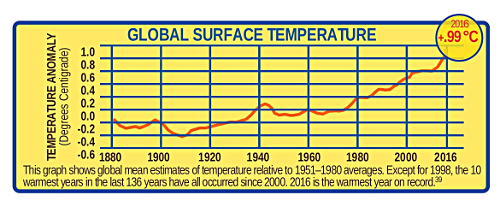
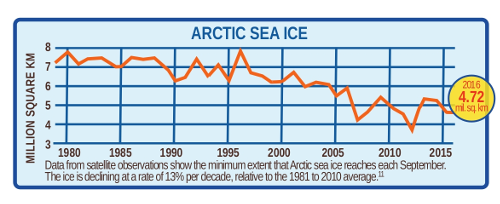 Indicators that the climate is changing include: rising mean temperatures; rising ocean temperatures; increased bounding main acidity; sea level rise; decrease of water ice in the Arctic and Antarctic; and retreat of almost all alpine glaciers. Recent studies show that the paths and speed of the northern jet stream (big rivers of wind loftier in the temper) are shifting because of warmer temperatures in the Chill—bringing colder winters
Today's climate change is from human causes
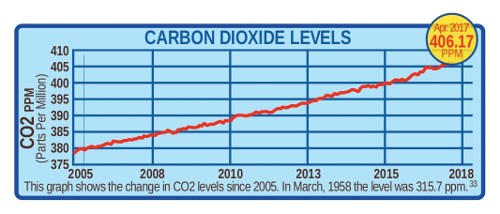 The ascendant cause of present-day climate change is the increase in carbon dioxide, methane and other greenhouse gases emitted into the atmosphere by human activities.* Higher concentrations of greenhouse gases are the predominant cause of warming temperatures—geological history shows that as levels of greenhouse gases increased, the earth warmed. Climatic change will likely be one of the primary drivers of extinction in the 21st century because of the speed at which average temperatures are warming—faster than at any time in the last 15,000 years.
* 97% of active climate scientists agree that today'due south climate change is acquired by man activities
Species are at hazard of extinction
A global mean temperature rise of 2 to iii °C will greatly increase the percentage of species at take a chance and amplify the unsafe impacts on biodiversity and ecosystems. If an ecosystem is already degraded from other causes not related to climate, such as pollution, a species is less resilient or probable to suit. The animals shown here illustrate the wondrous multifariousness of life on Earth, and too highlight the many ways climate change puts all forms of life on the planet, including humans, at risk.
Educational Poster and Presentation
"Wonderful project. ...the earlier nosotros convey this information to students the amend information technology is for the planet." Alexander More Historian and Climate Scientist, Harvard
"Very overnice graphics and of import messages." Dr. Paul Andrew Mayewski Director, Climatic change Institute Univ. of Maine
"Brilliant! Every bit a first, every loftier school science classroom should have a copy of this poster." Dr. Tara Martin IUCN Species Survival Commission'southward Climatic change Specialist Grouping
"An easy, responsible, engaging resource for explanation of a very complicated process and very critical condition." Peter Neill World Sea Observatory
"…brings essential conversation on climate change to the forefront through the utilize of this animal data to make the problem real." Jaclyn Stallard Project Learning Tree
"This poster is incredible!" Teaching Team Polar Bears International
"I am astounded at how crawly the poster is!" Wendy Foden Chair: IUCN Species Survival Commission'south Climate Change Specialist Grouping
"…a useful resource for teaching about climatic change in biological science, ecology science, and earth science classes…" Becky Remis National Earth Science Teachers Clan
"The presentation is extremely valuable for my work and teaching....Yous nowadays some of the findings better than I take in the original report." Wendy Foden Chair, IUCN Climate Change Specialist Group: Species Susceptibility to Climate Alter Impacts
"...a key piece of information in the first deep-dive unit I've ever washed on climatic change." Diana Allen President, Maine Science Teachers Association
scroll over to zoom.
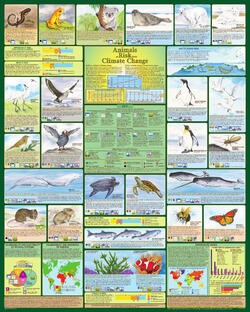
The Animals at Risk from Climate Change educational affiche presents a succinct overview of the cardinal impacts of greenhouse gases—the causes, furnishings and risks to all forms of life on the planet.
Past highlighting 25 animals selected for their vulnerability to climatic change, the complex interaction of biological traits and environmental conditions that cause a species to be susceptible are fabricated simple and understandable through illustrations, key graphics and cursory explanatory text.
24" 10 30", printed on FSC certified recycled paper.
The Presentation
The 75 page downloadable presentation includes all illustrations, keys, text and charts from "Animals at Risk from Climate change"—a unique and timely companion to the wall poster. The flexible PDF platform functions both as a carefully sequenced slide show and a set of printable handouts.
" The presentation is extremely valuable for my work and educational activity....Y'all present some of the findings improve than I accept in the original report."
~Wendy Foden, Chair, IUCN Climate Change Specialist Group: Species Susceptibility to Climatic change Impacts
Without the constraints of the printed format, we accept added a 15 page appendix detailing the complexities of topics that include: the sixth mass extinction; scientific consensus; education and climate change; volcanoes; water vapour; abrupt climate change; mitigation; and geoengineering.
A useful tool for classroom or public demonstrations; the synergy that comes from many people coming together and reaching a collective awareness has power and can exist the first of awareness and change.
Please note: the purchase of the presentation is intended for a single user. We are a small non-turn a profit organization, and then if you would like to share or distribute boosted copies, we ask that you purchase them, make a donation, or contact us and permit united states of america know. Many thanks.
Comprehensive and rigorously annotated to reliable sources, these resource are valuable, timely and relevant educational aids. If you lot are an educator, activist, retailer, or interested in becoming a sponsor to enable free distribution to teachers, please contact united states at mm@theglobaleducationproject.org or 250 895 4327.
Gild at present for your classroom or programs >>>
The Animals At Risk
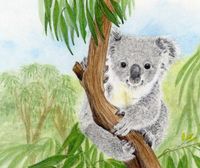 Koala
Koala
Koalas alive in the woodlands of Australia. Thick fur and skin make information technology difficult for them to adapt to rising temperatures. Increased CO2 in the air produces less protein in the eucalyptus leaves, forcing the Koala to search for other sources of food and, in times of high heat, water. On the ground, the slow moving Koalas are prey to wild dingoes and domestic dogs, or are hit by cars as they cross roads. Their habitats are also being destroyed past drought, bush fires and evolution.
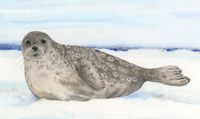 Ringed Seal
All populations of Ringed Seals are expected to be adversely afflicted by climate change because of dependence on body of water water ice and snow dens for breeding, protecting pups, moulting and resting. Early warming causes pups to divide prematurely from their mothers. As sea ice declines, other threats are fisheries by-catch, increased shipping, tourism and evolution. Seals are vulnerable to affliction from heavy concentrations of pollutants that take accumulated in the Arctic food web.
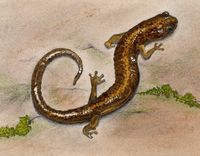 Shenandoah Salamander
The Shenandoah Salamander lives in an isolated, loftier altitude region of Shenandoah National Park, United states of america. Like all amphibians who take sparse, permeable peel, salamanders are very sensitive to environmental changes. If average temperatures or moisture increase, this salamander, restricted to its absurd micro-climate, will be at adventure—having no place to get simply to lower, even warmer, altitudes. If warming causes other species of lower altitude salamanders to migrate higher, they will compete for the Shenandoah's cool, moist habitats.
 Polar Carry
Polar Bears live but in the Arctic. Loss of sea ice has a critically adverse consequence on Polar Bears. They hunt from the edge and build snow dens on the ice for resting and raising their cubs. Body of water water ice decline could open the Arctic to aircraft and tourism, further agonizing Arctic habitats. Other threats are oil development and industrial pollution that reaches the Arctic through air and sea currents.
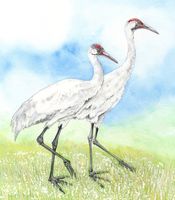 Whooping Crane
Before 1800 there were an estimated 10–xx,000 Whooping Cranes in North America. By 1941, because of hunting and habitat destruction, there were fewer than xx. There are at present approximately 350–380 in the wild. The wild Whooping Crane population has only one winter habitat—a wildlife refuge on the Gulf Declension in Texas; and one spring breeding habitat—a prairie wetlands in Alberta. Astringent storms, sea level ascent, drought, industrial development and oil spills threaten these habitats. Another significant threat to immature Whooping Cranes is colliding with power lines in their migration corridor.
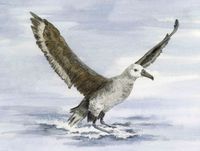 Black-footed Albatros
Almost all Blackness Footed Albatrosses live in the Hawaiian Islands. Like all species of albatrosses that breed on low lying beaches and slopes, they are highly susceptible to sudden flooding from sea level rise and storm surges. Thousands each year are defenseless by longline angling and they are also threatened by pollution and ingesting plastics that float in the body of water.
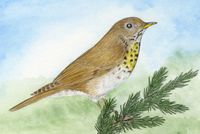 Bicknells Thrush
The breeding habitat of Bicknell's Thrush is primarily restricted to mountain spruce forests of Northeastern The states and Canada. They winter in the Caribbean and spring migration north is cued by day length. If bound arrives early in the north and the Thrushes go far at their normal time, the abundance of food—insects and fruit—would already have peaked. Warming temperatures also produce an abundance of bandbox and fir cones—feeding and increasing the population of Red Squirrels, a primary predator of eggs and chicks. Storms and hurricanes threaten the Thrush's tropical winter habitat. Pollution, logging and deforestation threaten their spring breeding and winter habitats.
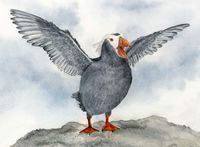 Tufted Puffin
Tufted Puffins are threatened by bounding main level rising and storm surges which destroy habitats and convenance areas. In some areas of N America warming seas are causing the fish that the Puffins feed on to migrate farther n, making it difficult for them to find adequate food. Other threats are entrapment in angling nets, oil spills, pollution, ingestion of plastic, man disturbance of breeding colonies and introduced predators such equally rats and foxes.
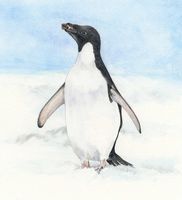 Adelie Penguin
In winter, the sun doesn't rise south of the Antarctic Circle. If Antarctic body of water ice decreases and does non extend far enough to the north, Adélie Penguins, during their wintertime migration, may not be able to reach the sunlight needed to navigate, chase and avoid predators—they won't swoop in the dark. Other threats are oil pollution, angling and disturbance of colonies from research stations and shipping.
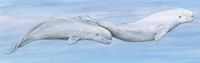 Beluga
Belugas live in Chill and Sub-Arctic waters. Impacts from climate alter include: an increase in ship traffic as sea ice declines, oil exploration and extraction, fisheries past-catch, and disruption of the food web. Equally Arctic waters warm and currents change, the Humpback (a competitor) and the Orca (a predator) may move north and stay longer. Some Beluga populations are also threatened by hunting, pollution and habitat loss.
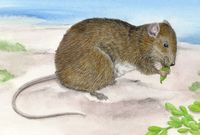 Bramble Cay Melomys
The Bramble Cay Melomys was the first species to exist declared extinct considering of climate change. Sea level rising and storm surges washed away its habitat, food and the terminal of the population. In 2014 scientists went searching in the hopes of starting a breeding plan simply were unable to find a pair. Other sea birds and turtles that live on the Cay are also threatened by storm surges and body of water level ascension.
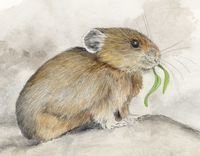 American Pika
American pikas occupy talus—rock piles that accumulate at the base of operations of a slope—at loftier elevations in western mountains. Pikas are thought to exist a prime example of the potential furnishings of climate change because they are sensitive to warm temperatures and rely on insulation provided by snow to survive cold winter temperatures. Still, several contempo studies point that pikas can exist resilient to each of these factors. Most pikas in the Sierra Nevada survived the winter of 2014, when at that place was well-nigh no snowpack. Pikas persist in many hot localities likewise, demonstrating their power to cope with high temperatures.
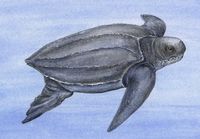 Leatherback Sea Turtle
Climate change impacts the Leatherback in two main ways: an increment in the temperature of nesting sands causes a greater proportion of females to hatch, destabilizing future populations; and sea level rise and stronger, more frequent storms erode nesting beaches and launder away eggs and hatchlings. The Leatherback is also threatened from fisheries by-catch, egg drove, coastal development, pollution and ingestion of floating plastics.
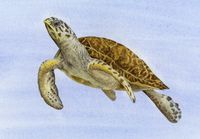 Hawksbill Bounding main Turtle
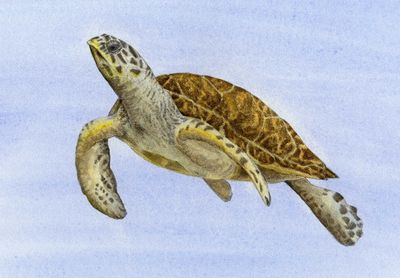
Climatic change may affect Hawksbill Turtles in various means because they live in different habitats at different stages of life: open sea, beaches, lagoons and coral reefs. Rise sand temperature of nesting beaches produces more than females and other abnormalities in infant turtles. Adults alive primarily in coral reefs—threatened by ascent ocean temperature and acidity. Since ancient times the Hawksbill has been exploited for its shell. They are besides threatened from fisheries by-catch, development, and a high sensitivity to oil spills. The population has decreased by an estimated 80% in the last 100 years.
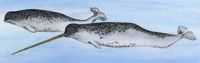 Narwhal
The Narwhal lives mainly in the Atlantic Arctic. Considering of specialized habitat, narrow range and limited diet (Arctic cod and halibut), it is one of the Arctic species about vulnerable to climate change. The Narwhal breeds in trophy and fjords, moving offshore during winter to areas of heavy ice pack, animate through the few cracks. Sudden or extreme temperature change can cause these cracks to freeze shut, trapping the whales. Other threats are illegal hunting, industrial activities, and risks from oil development, exploration and shipping in the Chill.
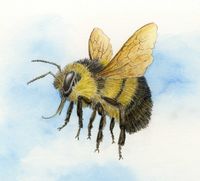 Rusty Patched Bumble Bee
The Rusty Patched is the commencement bee to be listed as endangered in the Us. Populations have declined as much as 87% from habitat loss, affliction and pesticides. Climate threats include: warming and precipitation, early on snow, late frost and drought. Bees and butterflies are important agricultural pollinators. In 2016, 40% of invertebrate pollinators (bees and butterflies) were listed as threatened with extinction.
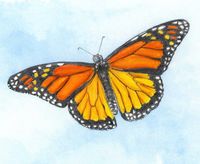 Monarch Butterfly
The almanac Northward American migration of the Monarch is listed as a "threatened phenomenon." Climate related threats include: drought, storms, changes in precipitation and dependence on temperature to trigger migration and reproduction. The Monarch feeds and lays eggs exclusively on milkweed plants, so information technology is besides highly vulnerable to herbicides and habitat devastation.
 Sockeye Salmon
For decades wild salmon populations take been in decline from human causes: over fishing; habitat deposition—logging, mining, agronomics and dams; pollution; and interaction with hatchery or farmed salmon. These weather and threats may hinder their power to adapt to the effects of climate change. Salmon thrive at specific freshwater temperatures—warming air raises water temperature. Early snow melt and increased rains cause concrete changes to spawning streams.
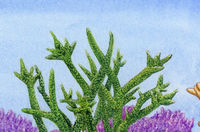 Staghorn Coral
In the last 30 years the Staghorn Coral population has decreased past lxxx% from disease, pollution, development and damage. Climate change is increasing the take a chance of extinction. Corals live in symbiotic (mutually beneficial) relation with algae. The coral receives nutrients and oxygen from algae, and the algae receive nutrients and carbon dioxide from the coral. Rising bounding main temperature increases algae growth then oxygen levels become too high for the coral, causing "bleaching"—the coral expels the algae and dies. Higher body of water acidity contributes to bleaching and besides reduces the ability of corals and other marine animals to build difficult shells. Other threats from climatic change are bounding main level rise, changes in currents and storm damage.
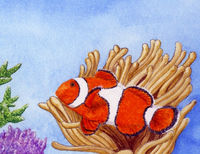 Common Clownfish
Clownfish live in the shallow waters of coral reefs where they take a mutually beneficial relation with a few species of sea anemone. The anenome protects the Clownfish, and the fish'southward swimming aerates the water effectually the anenome. Clownfish are unable to move long distances, and rising ocean temperature and acidity is a threat to their coral reef habitats. Increased acerbity as well seems to impair their power to navigate to their home anemones.
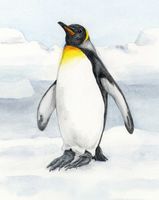 Emperor Penguin
In 50 years, the mean temperature of western Antarctica has risen nearly 3 °C—more than whatever other region—reducing the extent and thickness of winter ice. The Emperor Penguin is dependent on the ice for breeding, raising chicks and moulting. Less body of water ice decreases zooplankton (krill) which feed on algae that grow on the underside of the ice. Krill are an important part of the nutrient web for the Emperor and other Antarctic marine species.
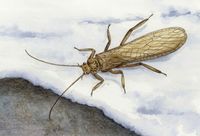 Western Glacier Stonefly
Since 1960, the average summer temperature in Glacier National Park has increased by around 1 °C and glaciers take declined past 35%. By counting Stoneflies, scientists tin determine how quickly glaciers are melting and the temperature of streams. In a two year search begun in 2011, scientists constitute the Stonefly in but one of the vi streams it had previously occupied and discovered that information technology had retreated to 2 different streams at higher altitudes. Satellite data confirm that the world'southward glaciers are failing, affecting the availability of fresh h2o for humans, animals and plants, and contributing to sea level rising.
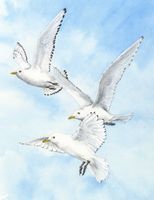 Ivory Gull
Ivory Gulls are nearly entirely dependent on sea water ice and glaciers for nesting and food foraging. They feed on fish and shellfish that thrive near the edge of the water ice, and on the remains of seals left by Polar Bears. Seal blubber is a source of heavy contaminants—Ivory Dupe eggs show a college concentration of mercury and pesticides than any Arctic sea bird. Other threats are illegal hunting and disturbance from diamond mining in the Canadian Chill.
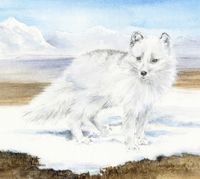 Chill Fox
The Arctic tundra is a region of shrubs, grasses and permanently frozen subsoil. Warming could change the tundra to boreal woods—habitat for the Red Fox. The Red Fox, a predator and a competitor for food, is already outset to migrate north into the Arctic Fox's territory. Milder tundra weather also causes changes in the population of lemmings and rodents—main food for the Arctic Play a joke on.



Source: https://www.theglobaleducationproject.org/climate-change/
Posted by: bookerestinabot1938.blogspot.com
0 Response to "How Can Animals Die From Climate Change"
Post a Comment