

How Do Plants Differ From Animals With Respect To The Way In Which They Acquire Nutrients?
The existence of life on the planet earth is mainly based on certain functions and processes. At that place are certain basic vital processes, which are essential for an organism to stay good for you and to maintain the proper functioning of the body's organ systems. They are necessary for survival. These basic essential activities performed by an organism are called life processes.
Important life processes include diet, transportation, metabolism, respiration, reproduction and excretion, which help in the maintenance of living organisms.
The topic of life processes had been discussed in several classes. Life processes Class 10 is a detailed version of different processes carried out by plants and animals.
Types of Life Processes
The dissimilar types of life processes are mentioned below:
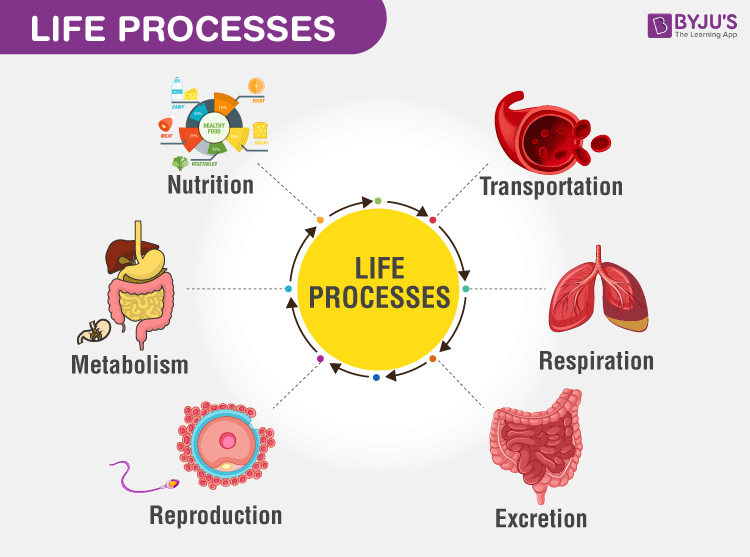
Important Life Processes
Nutrition
Nutrition is the process where an entity takes nutrient and utilizes it for energy. It is a pivotal biological process that helps living beings to obtain their energy from diverse sources.
Nutrients are the substances which provide nutrition based on body requirements.
Mode of diet varies from one species to another. All green plants exhibitautotrophic nutrition as they synthesize their food by the process of photosynthesis, using light, carbon dioxide and water.
Plants are autographs, they have an autotrophic mode of nutrition. They perform photosynthesis to prepare their own nutrient. Animals are grouped into a heterotrophic mode of diet, as they depend on plants for food. All vertebrates, including humans and some unicellular organisms such as amoeba showroom the holozoic mode of nutrition.
Explore more than:Nutrition
Transportation
Transportation or transportation arrangement in plants and animals are entirely different. In animals, transportation is carried out through the circulatory arrangement. This system includes the middle, blood, and claret conveying blood vessels.
Plants accept particular tissues called vascular tissues for the conduction and transportation of materials throughout the establish parts. Vascular tissues include xylem and phloem.
Xylem conducts water and minerals from roots to shoot system while phloem transports prepared food from leaves to other plant parts.
Explore more: Transportation in Animals and Plants
Metabolism
Metabolism is the chemical procedure in which unlike types of chemic reactions are involved in decision-making the living state of the cells in an organism. It is broadly classified into catabolism and anabolism.
Catabolism: The metabolic procedure in which energy is released.
Anabolism: The metabolic process in which energy is stored for farther requirements.
Explore more: Metabolism
Respiration
Respiration includes the exchange of gases equally well as the called-for of food. Animals have a well-defined respiratory organization for respiration.
In the process of respiration, glucose is broken down to extract energy. Information technology is a redox reaction which can take place with or without oxygen and takes place in the mitochondria of the cell and releases free energy in the course of ATP.
Respiration is mainly of two types- aerobic respiration and anaerobic respiration.
Explore more than: Respiration
Reproduction
The biological process of reproducing their ain offspring determines the continuity of species, generation afterwards generation. The basic types of reproduction are sexual and asexual reproduction.
Sexual Reproduction: The process of reproducing their own offspring by the involvement of the ii parents.
Asexual Reproduction: The process of reproducing their own offspring by the involvement of a single parent.
Explore more: Modes Of Reproduction
Excretion
Elimination of toxic waste substances from the body is called excretion. In that location are various modes of excretion and it generally differs with the different types of living species.
Plants have unlike modes of excretion. The oxygen during photosynthesis and carbon dioxide during respiration are given out through a construction chosen stomata. Excess water is removed by transpiration. They shed expressionless cells and fifty-fifty plant parts similar leaves. Waste products are besides stored in vacuoles and leaves that fall off. Other waste products include gums and resins, etc.
Humans take a well developed excretory system consisting of a couple of kidneys, ureter, urinary bladder and urethra. Kidney has a structural unit called nephron where the blood is filtered. After filtration, the pure claret circulates back to other parts and extracted waste products are passed into the ureter. The urinary bladder collects urine, which is excreted through the urethra.
Explore more: Human Excretory Organisation
Difference between Plants and Animals Life Processes
Post-obit are the important difference between the life processes of plants and animals.
| Plants | Animals |
| Meaning | |
| These are green in colour due to the presence of chlorophyll and provide oxygen to the atmosphere. | The animals cannot ready their own food and consist of a specialized system to carry out dissimilar life processes. |
| Locomotion | |
| Plants are rooted in the ground and cannot move from one place to another. | Animals can freely move from one place to another. |
| Diet | |
| Plants are autotrophs and can prepare their own nutrient. | Animals are heterotrophs and depend on plants and other animals for their food. |
| Food Storage | |
| Plants store food in the grade of starch. They practise not have any digestive system. | Animals have a well-developed digestive system and can store their food in the form of glycogen. |
| Respiration | |
| Respiration in plants takes identify through the stomata. | Substitution of gases occurs through lungs, gills, pare, etc. |
| Reproduction | |
| They reproduce asexually through budding, vegetative propagation, etc. They also reproduce sexually by a procedure called pollination. | Animals mostly reproduce sexually. Asexual reproduction occurs in lower animals by fragmentation and budding. |
| Response to Stimulus | |
| They evidence response to stimuli like light and touch. They are less sensitive because they do non have sense organs. | They have a well-adult nervous organization and respond to whatsoever stimulus inside fractions of seconds. |
Explore more: Difference Between Flora and Beast
For more detailed data about life processes Grade 10, go along visiting the BYJU'S website or download BYJU'S app for further reference.
Frequently Asked Questions
What do you understand past life processes?
The bones important activities performed by an organism to withstand life are chosen life processes. These assist an organism in maintenance and survival.
What are the different life processes in human beings?
The different life processes in man beings include-diet, respiration, digestion, excretion, reproduction, metabolism and transportation. These processes are very important to carry out regular life activities.
Which life processes tin exist observed in plants?
The life processes carried out in plants are slightly different from those observed in animals. The life processes in plants include- diet, transportation, excretion, respiration, reproduction, sensitivity and growth.
What is the importance of life processes?
Life processes are important to carry out daily life activities. They assistance to produce energy and maintain homeostasis in the body. The life processes help a torso survive with the changes in the environs. A slight disturbance in whatsoever of the life processes disturbs the unabridged functioning of the trunk.
What are the common life processes in both plants and animals?
The common life processes in plants and animals include- respiration, growth, nutrition, transportation, reproduction and excretion. These are carried out by all the plants and animals, digestion being an exception.
How does respiration help in carrying out life processes?
The process of respiration utilizes food to produce free energy. It oxidizes carbohydrates to produce energy. The free energy released is stored in the form of ATP. Mitochondria is the site of respiration.
Source: https://byjus.com/biology/life-processes/
Posted by: bookerestinabot1938.blogspot.com
0 Response to "How Do Plants Differ From Animals With Respect To The Way In Which They Acquire Nutrients?"
Post a Comment